For many years, “Attract, Engage, Delight” was the closest thing B2B marketing had to gospel. HubSpot built an entire company (and an entire industry’s vocabulary) on the inbound methodology: publish valuable content, get found on Google, nurture leads through a funnel, turn customers into promoters. It worked because search was predictable and buyers moved through a mostly linear path.
That predictability is gone. HubSpot’s answer is Loop Marketing: a new operating framework the company is positioning as the successor to classic inbound. If you lead sales or marketing at a B2B company, this isn’t a rebrand you can skim past. It changes how pipeline gets built.
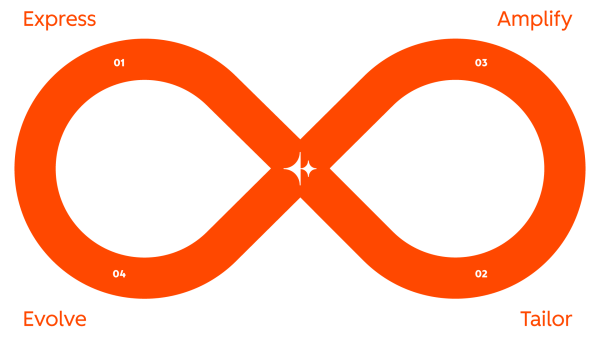
Loop Marketing is HubSpot’s AI-era framework for how companies should attract, convert, and grow customers when buyer discovery no longer runs primarily through Google search. Instead of a linear funnel, it’s structured as a continuous four-stage cycle:
The stages feed into each other and repeat. There’s no “delight” endpoint. Customer data from later stages loops back to sharpen brand definition and targeting in the next cycle. That looping structure is where the name comes from, and it’s the core mechanical difference from inbound.
It’s worth being precise here, because HubSpot’s own messaging is doing two things at once. In its FAQ content, HubSpot says Loop Marketing “enhances and evolves” inbound rather than replacing it outright. The customer-centric foundation stays intact, as it should.
At the same time, HubSpot has retired the three-stage Attract, Engage, Delight model as its flagship framework in favor of Loop. For a B2B leader, the practical takeaway is the same either way: the operating model you’ve been running your team on is no longer HubSpot’s recommended one.
Here’s what’s genuinely different:
Inbound assumed a beginning, middle, and end. A prospect enters at Attract and exits, delighted, at the far side if all goes well. Loop Marketing has no exit point. Data from existing customers continuously reshapes how you define your brand and target new segments, so the “loop” never closes.
Inbound was built for an era when ranking on Google’s first page was the main growth lever. HubSpot is explicit that AI Overviews and zero-click search have created what it calls a “traffic apocalypse” for organic content. Buyers get answers without ever clicking through. Loop Marketing adds Answer Engine Optimization (AEO), also called Generative Engine Optimization (GEO). This is the act of structuring content so AI systems cite and surface your brand inside generated answers, not just in blue links.
Inbound was primarily an organic and earned-media play, with paid running alongside it as a separate lane. Loop Marketing treats organic content, paid, outbound, and partner channels as one system, run from a single documented point of view, because B2B buyers are now discovering vendors on LinkedIn, YouTube, podcasts, and niche communities as often as on Google.
Inbound optimization often ran on a quarterly or annual cadence. Loop Marketing is built for AI-assisted testing and iteration on a weekly or even daily rhythm.
The customer-centric premise underneath all of it is the same: understand your buyer, create genuine value, build trust before you ask for the sale. Loop Marketing isn’t a license to spam AI-generated content across every channel, even though many marketers treat it that way. HubSpot’s own materials stress that the Express stage exists precisely to stop that from happening.

This isn’t a marketing-team-only conversation. There are several reasons why it belongs on the leadership agenda.
If a meaningful share of your buyers’ research now happens inside AI tools rather than search results, your existing SEO investment doesn’t automatically transfer. Content that isn’t structured for AEO/GEO can lose visibility even while your Google rankings stay flat. That’s a gap most dashboards won’t show you until your pipeline starts to dry up.
The Tailor and Evolve stages depend on unified CRM, sales, and customer success data. If marketing, sales, and customer data live in disconnected systems, you can’t run Loop Marketing: you can only run a slower, manual version of it. That’s a RevOps and data-architecture problem before it’s a content problem. Read this blog post about what RevOps is if this is new to you.
HubSpot’s own framing is candid: the first loop cycle feels awkward, but by the third or tenth cycle, teams that have adopted continuous optimization build a lead that’s hard for slower-moving competitors to close. In competitive B2B categories, that compounding gap is a real strategic risk if a competitor gets there first.
Brand voice documentation (the Express stage) becomes infrastructure, not a nice-to-have brand exercise. Executives who treat brand definition as marketing fluff will find their AI-assisted content sounds like everyone else’s AI-assisted content. And that is the opposite of a differentiator.
Full Loop Marketing implementations require capable marketing and CRM tooling and, per early cost estimates, can run from roughly €1,500 to €5,000+ per month depending on scope. That is a decision that sits with executives, not just with marketing managers.
Loop Marketing is designed to layer onto existing inbound assets rather than having to start over. A practical starting sequence for a B2B team:
Not sure which one fits your team? Get in touch and we’ll walk through your actual sales and marketing process. We don’t do pre-baked recommendations, there is no ‘one size fits all’ answer. We have a habit of giving you an honest read on what fits the best for your organization.
Book some time with our team to learn more about Loop Marketing and what it could mean specifically for your organization.